
Let's start with what's actually happening
Your partner comes home tired. They kiss you, touch you for maybe ninety seconds, and the assumption is that you're ready. The thing is, you're not. Your body needs fifteen minutes to warm up, and they're already expecting penetration. This isn't a crisis. It's also not rare.
Many couples hit a phase where foreplay compresses. It happens after kids, during work stress, when one partner's libido stays high but their initiation style gets rushed. The tension you feel isn't "my partner doesn't care about me." It's "our rhythms don't sync anymore." Those are totally different problems with totally different fixes.
Here's the thing nobody tells you: a lemon clitoral vibrator isn't a band-aid for this. It's a communication tool. It reshapes the conversation from "you're not doing enough" to "here's what I need, and here's how I can help myself get there."
Why the timing gap exists (and it's not what you think)
Forty percent of long-term couples report some mismatch in foreplay duration. It's not always about desire. It's about cognitive load. The partner who's been managing emails, kids, logistics, or stress all day is running on fumes. Their arousal doesn't follow the same slow build yours does. They're literally neurologically stuck in activation mode.
Meanwhile, you need transition time. Your nervous system needs to downshift from the day. Your body needs blood flow to gather at the clitoris, lubrication to increase, sensitivity to sharpen. That takes time. There's no "getting over it."
When foreplay shrinks, one of two things usually happens. Either you both settle for less satisfying sex, or resentment creeps in. "They never touch me anymore." "You take forever to get ready." Both are kind of true, and both miss the point. What you actually need is a bridge.
How a lemon vibrator becomes that bridge
The Lem is specifically designed for efficient, intense clitoral stimulation. It doesn't require the pressure and stamina that manual foreplay demands. When your partner initiates with less time, you can say, "I'm into this. I also need a few minutes to get there. I'm going to use my vibrator while we kiss. It gets me to the same place, just faster."
This does three things at once.
First, it moves the pressure off your partner. They're not suddenly responsible for doing thirty minutes of foreplay to "earn" your readiness. You're taking ownership of your own arousal, which is actually incredibly hot to most partners once the defensiveness drops.
Second, it shortens the gap without sacrificing sensation. A good clitoral vibrator gets you to peak arousal in five to eight minutes. Manual stimulation? Depends on the day, the light, your stress level. Vibration is consistent.
Third, it reframes the whole moment. Instead of "my partner doesn't know how to turn me on," the story becomes "my partner and I have found a way to meet in the middle." That's a partnership move, not a consolation prize.
The mechanics when time is short
Let's get practical. Your partner initiates with fifteen minutes before they need to leave the room again, or they're genuinely too tired for long foreplay but still want connection.
Start with kissing and touching that you both enjoy. This is non-negotiable. Two minutes of actual skin contact. Then introduce the vibrator. Not as a replacement for them, but as an addition. They touch you somewhere else. Your inner thigh, your breast, your neck. You guide the vibrator. The combination of their touch plus vibration creates a fuller sensory experience than either alone.
With a lemon clitoral vibrator, start on the lower settings. Patterns 1 or 2. You're not trying to race to orgasm. You're waking up your body. Your partner can feel the vibration through your skin as they touch you. Many couples find this more intimate, not less.
Set a time boundary together. "I need seven minutes with this, then we can go from there." Having an agreement takes the weirdness out of it. No one's silently clock-watching or wondering if you're stalling.
If orgasm happens, great. If it doesn't, you're still significantly more aroused than you were, and the sex that follows will feel better for both of you. That's the actual goal.
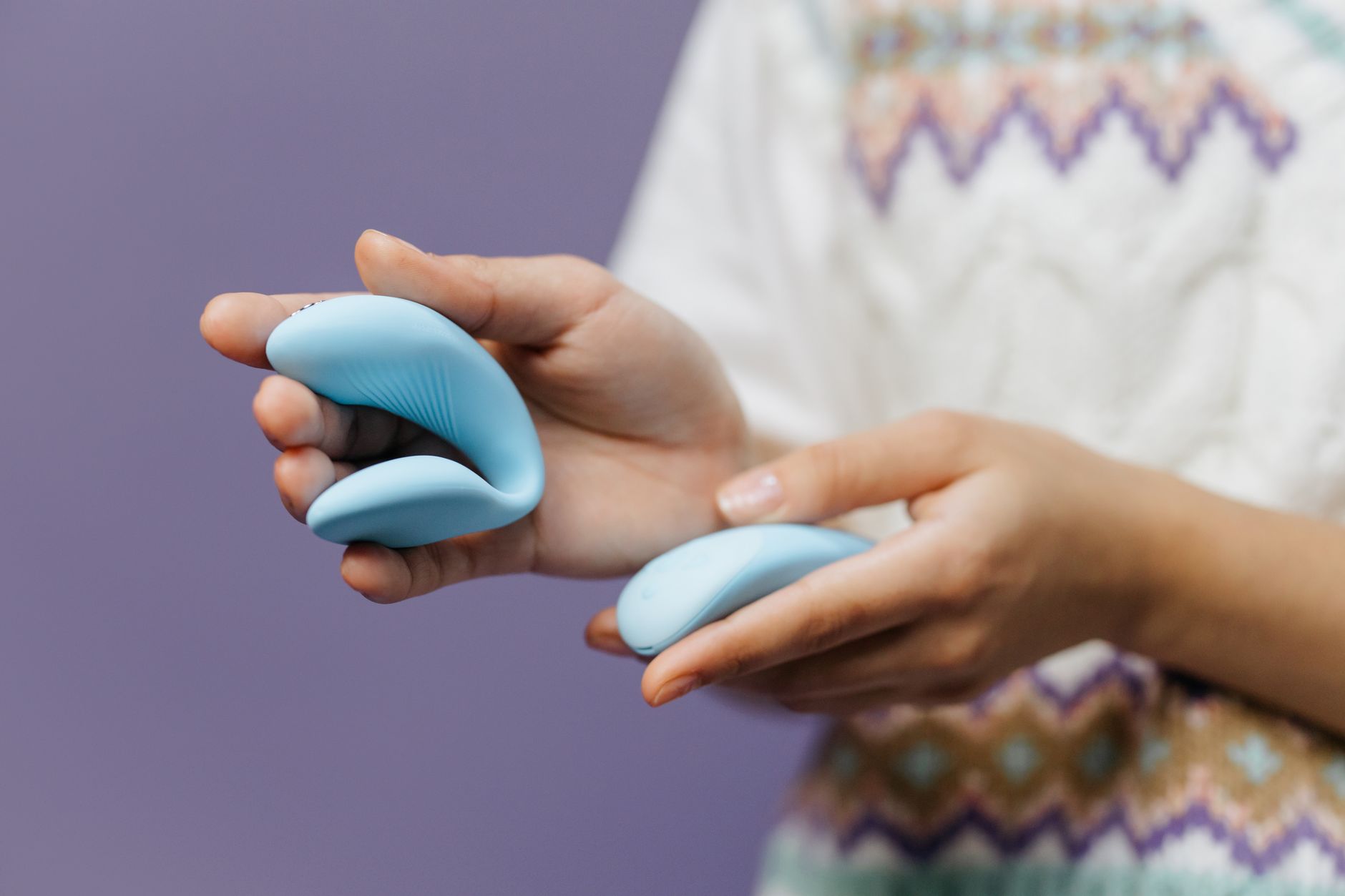
Photo by cottonbro studio on Pexels
What changes about your pleasure
When you shift to this setup, a few things happen that might surprise you.
Your orgasms often feel different. Faster, maybe sharper. The clitoral suction sensation on a lemon sucker style vibrator is more direct than manual stimulation, and your nervous system knows the difference. Some people find this more intense. Others find it lets them stay present with their partner longer because they're not anxious about "taking too long."
Your ability to be touched during arousal might expand. When you're not stressed about your partner getting bored, their hands can explore. You can actually receive their touch instead of bracing for it to stop. That's a real shift in how sex feels.
Your communication muscle gets stronger. Using a vibrator requires naming what you want and when. That skill transfers everywhere. It gets easier to say "a little slower" or "different angle" during sex, which makes everything better for both of you.
One more thing: many people report that sex feels less performative when a vibrator is part of the routine. You're not frantically trying to come before your partner gets frustrated. You're not faking it to get it over with. You're actually present. That's a massive upgrade.
When your partner feels threatened by the vibrator
This is real. Some partners see a vibrator and hear "you're not enough." That's not true. But it's a belief you have to address directly.
The reframe is: "This isn't about you. This is about my body being slow to wake up. I need this tool so I can actually enjoy what we're doing together." If your partner has insecurity about their ability to please you, the vibrator can feel like evidence that they're failing. So name the actual fact. "My body takes time to get aroused. That's physiology, not a reflection on you. Using this together means we get more time feeling good, not less."
Some partners worry about ED or about not being "needed." Show them that you still want their touch. The vibrator is doing one job. They're doing another. Both matter. If your partner can actually relax because they're not carrying the entire burden of your arousal, their performance usually improves. Less pressure = better sex for everyone.
If after a clear conversation your partner is still resistant, that's a different conversation. That's about control or insecurity that goes beyond this moment. That's worth exploring separately, possibly with a therapist.
The bigger picture
When foreplay gets shorter, sex can start to feel obligatory. You go through the motions. You might not even reach orgasm because you're so stuck in your head. A lemon clitoral vibrator gives you agency. It says: I'm not waiting around for the perfect conditions. I'm creating them.
That's not selfish. That's actually one of the most generous things you can do in a partnership. When you take responsibility for your own pleasure, you take pressure off your partner. When you're genuinely enjoying yourself, they feel it. Your pleasure becomes something you're creating together, not something they're supposed to produce.
Short foreplay doesn't have to mean disappointing sex. It just means you need to be more intentional about how you spend those minutes. A vibrator isn't a workaround. It's a tool that lets both of you show up for what you both want.
People also ask
Can I use a lemon vibrator if my partner is inside me?
Yes. External clitoral vibrators work beautifully during penetration. You can hold it against your clitoris while your partner moves inside you. This actually makes orgasm much more likely for people who need clitoral stimulation to come. If your partner worries about the vibration bothering them, it's minimal. They might even feel it, which some find pleasurable.
What if my partner says the vibrator is "not natural"?
Neither is birth control, antidepressants, or running water. Natural isn't the bar. Pleasure and connection are. A lemon sexual toy is designed specifically to help your body respond. That's a feature, not a flaw. If your partner has genuine philosophical concerns about sexual aids, that's a conversation worth having. But often "not natural" is code for "I feel insecure." Address the insecurity, not the vibrator.
Does using a vibrator make it harder to orgasm without one?
Not inherently. Your body adapts to whatever stimulation it receives regularly. If you use a vibrator every time, sometimes you might find manual stimulation feels less intense by comparison. The fix is simple: mix it up. Use the vibrator sometimes, use your partner's hands sometimes, use your own hands sometimes. Variety keeps your nervous system responsive.
How do I introduce this if we've never talked about toys before?
Start outside the bedroom. "I read something interesting. Some couples use vibrators to bridge timing gaps. We don't have to, but I'm curious what you think." Don't spring it on them mid-sex. Give them time to process. Answer questions. Be clear about why you want to try it. Then, if they're open to it, introduce it slowly. Show them how it works. Let them touch it. Destigmatize it before it's actually part of your intimate time.
Will a lemon clitoral vibrator work for me if I have low sensitivity?
Likely yes. Clitoral suction vibrators like the Lem work through a combination of vibration and gentle suction, which stimulates nerves differently than direct pressure. Many people with reduced sensitivity find them more effective than traditional vibrators. If you're unsure, check the return policy and test it with minimal expectations. Sometimes a different type of stimulation unlocks sensation that other methods don't.
What settings should I use if time is really limited?
Start with settings 1 or 2, even if you normally use higher settings. Lower intensity gives you sensation without the "racing to finish" feeling. You can always increase if you need to. If you only have five minutes, focus on consistent rhythm rather than building intensity. Your nervous system responds faster to predictability than to gradual escalation.
The conversation you actually need to have
Using a vibrator when foreplay gets short is the practical fix. But the real issue is that you and your partner have different baseline arousal speeds, and you haven't made a plan for that difference.
So have the conversation. "Our bodies have different rhythms. I need longer warm-up time. You're getting ready faster. Neither of those is wrong. I want to find a way that works for both of us." Then together, decide if a vibrator fits that solution. Maybe it does. Maybe what you actually need is him initiating earlier, or you initiating sometimes, or you building arousal separately before sex even starts.
The vibrator is just one tool. But it's a tool that says: I'm not settling for less, and I'm not going to resent you for your body's pace. I'm going to take care of myself, and we're going to find a rhythm that feels good for both of us.
That's the conversation that actually saves sex in long-term relationships. Everything else is logistics.